






-
SILICON VALLEY: Indian-origin executive named CEO of Microsoft Gaming - March 5, 2026
-
WASHINGTON: Indian-American lawyer at center of Trump’s biggest legal setback - March 4, 2026
-
TEXAS: ’15 of my cousins came here on H-1B’ - March 3, 2026
-
NEW YORK: Indian-origin doctor shares mother’s immigrant success journey in US - March 2, 2026
-
ARIZONA: Indian-origin scientist wins Arizona State University’s top Science Prize - March 1, 2026
-
WASHINGTON: Balaji Krishnamoorthy becoming Uber CFO amid ongoing visa row - February 28, 2026
-
LUCKNOW: Prime Minister Narendra Modi on HCL-Foxconn chip facility in UP - February 27, 2026
-
WASHINGTON: 55% Indian Americans Disapprove Of Trump’s India Policies: Survey - February 26, 2026
-
WASHINGTON: Trump Praises Indian American Harmeet Dhillon Amid Harvard Case - February 26, 2026
-
MUMBAI: Ranbir Kapoor to set up new RK Studios - February 25, 2026


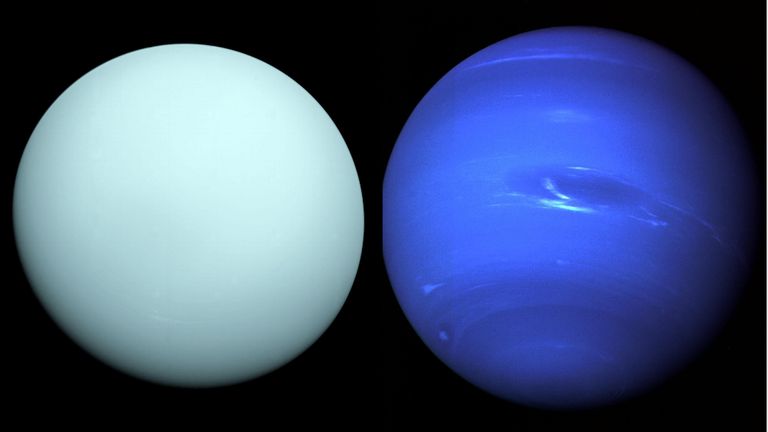
BERLIN: Scientists discover why Neptune and Uranus are different colours despite similarities
BERLIN: Scientists have explained why Neptune and Uranus are different colours despite having much in common.
The two furthest planets from the Sun are similar in mass, size and atmospheric composition but Neptune is distinctly bluer than its neighbour.
A new study by Oxford University has suggested the reason for this is because of a layer of haze on both planets.
Their appearances would be identical if it wasn’t for this haze, lead author Professor Patrick Irwin said.
Using observations from the Hubble Space Telescope, the NASA infrared telescope facility and the Gemini North Telescope, researchers have developed a model to describe aerosol layers in the atmosphere of both planets.
The model involves three haze layers at different heights.
On Uranus, the middle layer of haze is thicker than on Neptune, which affects the visible colour.
Scientists also said methane ice condenses in the middle layer of both planets, forming a shower of methane snow that pulls the haze particles deeper into the atmosphere.
Neptune has a more active and turbulent atmosphere, suggesting it is more efficient at producing the snow which removes more of the haze and keeps Neptune’s middle layer thinner.
Therefore, Neptune appears bluer, while excess haze on Uranus builds up in the sluggish atmosphere and causes a lighter shade.
The model also showed the presence of a second, deeper layer.
When it gets dark, this causes dark spots on Neptune such as the famous Dark Spot GDS-89.
Professor Irwin said: “This is the first model to simultaneously fit observations of reflected sunlight from ultraviolet to near-infrared wavelengths.”
Explaining the difference in colour between the planets was an “unexpected bonus” of the model, according to co-researcher Dr Mike Wong from the University of California.
About the Author

Some Related Posts
-
BERLIN: Astronomers call for renaming the Magellanic Clouds
BERLIN: Names have significance, especially when they’re written in the s -
BERLIN : Electric robots are mapping the seafloor, Earth’s last frontier
BERLIN : For centuries, humans have explored the Earth’s mountains, j -
CALIFORNIA: This giant bacterium is the largest one found yet
CALIFORNIA: The newfound species, Thiomargarita magnifica, is roughly a cen -

BERLIN: Cats chewing on catnip boosts the plant’s insect-repelling powers
BERLIN: Catnip is known to bug bugs. When a cat chews, licks and destroys c -
BONN: Physicists may have finally spotted elusive clusters of four neutrons
BONN: For six decades, researchers have hunted for clusters of four neutron