






-
SILICON VALLEY: Indian-origin executive named CEO of Microsoft Gaming - 2 days ago
-
WASHINGTON: Indian-American lawyer at center of Trump’s biggest legal setback - March 4, 2026
-
TEXAS: ’15 of my cousins came here on H-1B’ - March 3, 2026
-
NEW YORK: Indian-origin doctor shares mother’s immigrant success journey in US - March 2, 2026
-
ARIZONA: Indian-origin scientist wins Arizona State University’s top Science Prize - March 1, 2026
-
WASHINGTON: Balaji Krishnamoorthy becoming Uber CFO amid ongoing visa row - February 28, 2026
-
LUCKNOW: Prime Minister Narendra Modi on HCL-Foxconn chip facility in UP - February 27, 2026
-
WASHINGTON: 55% Indian Americans Disapprove Of Trump’s India Policies: Survey - February 26, 2026
-
WASHINGTON: Trump Praises Indian American Harmeet Dhillon Amid Harvard Case - February 26, 2026
-
MUMBAI: Ranbir Kapoor to set up new RK Studios - February 25, 2026


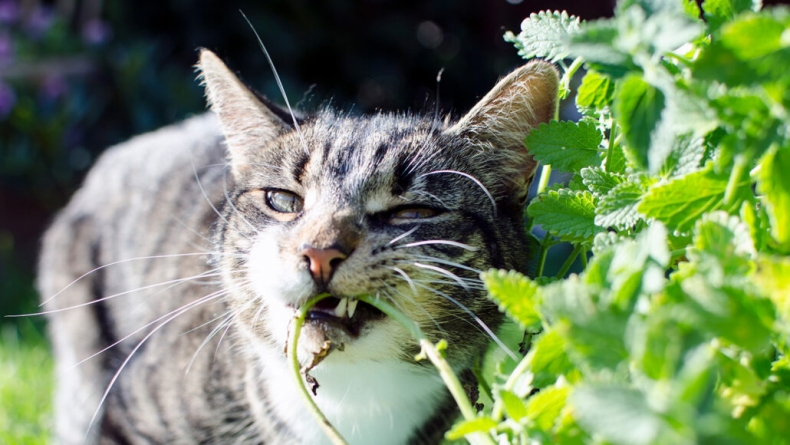
BERLIN: Cats chewing on catnip boosts the plant’s insect-repelling powers
BERLIN: Catnip is known to bug bugs. When a cat chews, licks and destroys catnip, the plant releases more insect-repelling compounds, a new study finds. For many cats, a mere whiff of catnip can send them into a licking, rolling, plant-shredding frenzy.
That destruction amplifies catnip’s natural defenses against insects and its appeal to cats, a new chemical analysis finds. Compared with intact leaves, crushed-up leaves emit more volatile compounds called iridoids, which act as an insect repellant, researchers report June 14 in iScience. The higher emissions also seem to encourage cats to continue rolling around in the remains of the plant, effectively coating themselves in a natural bug spray.
Masao Miyazaki, a biologist at Iwate University in Morioka, Japan, and his colleagues analyzed the chemistry of both catnip (Nepeta cataria) and silver vine (Actinidia polygama), a plant common in Asia that has a similar euphoric effect on cats. Both plants naturally produce iridoids, which discourage insects from snacking on leaves.
As cats toyed with silver vine, the damaged leaves released about 10 times more iridoids than intact leaves did, and also changed the proportion of the chemicals released. The researchers also found that catnip when crushed up released over 20 times more of its insect repellant, mostly a type of iridoid called nepetalactone.
With both plants, lab-made iridoid cocktails mimicking those of damaged catnip and silver vine chased off more mosquitoes than chemical solutions that mirrored those of intact leaves, the study found.
The team also presented cats with two dishes — one with intact silver vine and one with damaged leaves. Without fail, the cats would go to the damaged leaf container and lick and play with the dish and roll against it.
About the Author

Some Related Posts
-

BERLIN: Astronomers call for renaming the Magellanic Clouds
BERLIN: Names have significance, especially when they’re written in the s -
BERLIN : Electric robots are mapping the seafloor, Earth’s last frontier
BERLIN : For centuries, humans have explored the Earth’s mountains, j -
CALIFORNIA: This giant bacterium is the largest one found yet
CALIFORNIA: The newfound species, Thiomargarita magnifica, is roughly a cen -
BONN: Physicists may have finally spotted elusive clusters of four neutrons
BONN: For six decades, researchers have hunted for clusters of four neutron -

BERLIN: Scientists discover why Neptune and Uranus are different colours despite similarities
BERLIN: Scientists have explained why Neptune and Uranus are different colo