






-
SILICON VALLEY: Indian-origin executive named CEO of Microsoft Gaming - March 5, 2026
-
WASHINGTON: Indian-American lawyer at center of Trump’s biggest legal setback - March 4, 2026
-
TEXAS: ’15 of my cousins came here on H-1B’ - March 3, 2026
-
NEW YORK: Indian-origin doctor shares mother’s immigrant success journey in US - March 2, 2026
-
ARIZONA: Indian-origin scientist wins Arizona State University’s top Science Prize - March 1, 2026
-
WASHINGTON: Balaji Krishnamoorthy becoming Uber CFO amid ongoing visa row - February 28, 2026
-
LUCKNOW: Prime Minister Narendra Modi on HCL-Foxconn chip facility in UP - February 27, 2026
-
WASHINGTON: 55% Indian Americans Disapprove Of Trump’s India Policies: Survey - February 26, 2026
-
WASHINGTON: Trump Praises Indian American Harmeet Dhillon Amid Harvard Case - February 26, 2026
-
MUMBAI: Ranbir Kapoor to set up new RK Studios - February 25, 2026


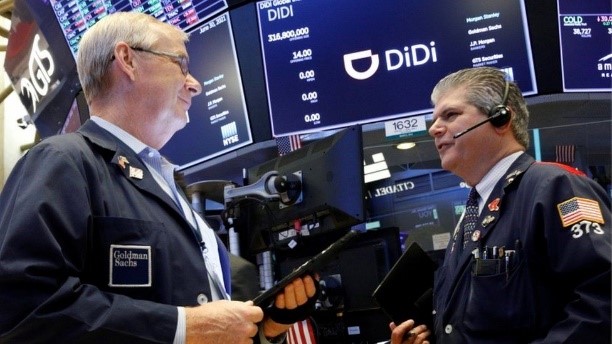
BEIJING: Didi: Chinese ride-hailing giant makes $68bn US debut
BEIJING: Chinese ride-hailing giant Didi
Global has ended its first day on the New York Stock Exchange with a valuation
of $68.49bn (£49.6bn).
That is
even as its shares closed just 1% higher than their $14 offering price after
slipping back from earlier strong gains.
It was
the biggest listing in the US by a Chinese company since Alibaba’s debut in
2014.
China’s
answer to Uber raised $4.4bn in the Initial Public Offering (IPO).
It is the
latest in a series of Chinese companies to cash in on the booming US stock
market.
In the
first six months of the year, some 29 Chinese companies raised a total of
$7.6bn in IPOs, according to financial markets data provider Refinitiv.
This is
despite years of tensions between Washington and Beijing, and concerns raised
by US regulators over some Chinese firms’ financial reports.
Didi had
originally hoped for a valuation of as much as $100bn, according to a Reuters
report in March.
Those
expectations were said to have been scaled back after potential investors
voiced concerns about the speed and profitability of the firm’s expansion
plans.
Didi,
like the majority of ride-hailing platforms, had been loss-making until it
reported a $30m profit for the first three months of this year.
In 2020,
it reported a $1.6bn annual loss as the business was hit by the pandemic.
In June
this year, it was reported that Didi was being probed by China’s market
watchdog. The State Administration for Market Regulation was investigating
whether it had unfairly squeezing out smaller rivals, according to Reuters.
Beijing
has been increasingly reining in the country’s technology giants, including
Alibaba and Tencent.
The
company’s founder Cheng Wei has said he had the idea to launch a ride-hailing
platform in 2012 after he struggled to book a taxi on a freezing night in
Beijing.
Mr Cheng
will own a 6.5% stake in the company, while having a 35.5% voting power due to
a dual-class share structure that is popular among technology firms.
Japan’s
SoftBank is Didi’s largest single investor with a stake of more than 20%. It is
also backed by Chinese technology giants Alibaba and Tencent.
Uber also
owns 12% of the firm as a result of Didi taking over Uber China in 2016.
About the Author

Some Related Posts
-

BEIJING : Apple begins making iPhone 14 in India 3 weeks after launch
BEIJING : Apple has begun manufacturing its new iPhone 14 in India, narrowi -

BEIJING : Five Chinese state-owned companies to delist from NYSE amid US tensions
BEIJING : Five Chinese state-owned companies, including oil giant Sinopec a -

BEIJING: China, India may be buying more Russia oil than known, US says
BEIJING: China and India may be buying more Russian oil than the US previou -
BEIJING: US surpasses China as India’s biggest trading partner in FY22 at $119.42 bn
BEIJING: The US surpassed China to become India’s top trading partner -
BEIJING: Global investors flee China fearing that risks eclipse rewards
BEIJING: A growing list of risks is turning China into a potential quagmire