






-
SILICON VALLEY: Indian-origin executive named CEO of Microsoft Gaming - March 5, 2026
-
WASHINGTON: Indian-American lawyer at center of Trump’s biggest legal setback - March 4, 2026
-
TEXAS: ’15 of my cousins came here on H-1B’ - March 3, 2026
-
NEW YORK: Indian-origin doctor shares mother’s immigrant success journey in US - March 2, 2026
-
ARIZONA: Indian-origin scientist wins Arizona State University’s top Science Prize - March 1, 2026
-
WASHINGTON: Balaji Krishnamoorthy becoming Uber CFO amid ongoing visa row - February 28, 2026
-
LUCKNOW: Prime Minister Narendra Modi on HCL-Foxconn chip facility in UP - February 27, 2026
-
WASHINGTON: 55% Indian Americans Disapprove Of Trump’s India Policies: Survey - February 26, 2026
-
WASHINGTON: Trump Praises Indian American Harmeet Dhillon Amid Harvard Case - February 26, 2026
-
MUMBAI: Ranbir Kapoor to set up new RK Studios - February 25, 2026


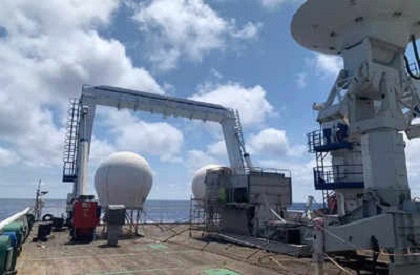
SUVA : Isro eyes Fiji Islands, other locations for Aditya-L1 temp tracking station
SUVA : The Indian Space Research Organisation (Isro), which already has a network of tracking stations, has completed survey and radiation studies at Fiji Islands for a temporary station being designed specifically for India’s first Solar mission (Aditya-L1), while exploration of other sites is ongoing.
Fiji Islands is one of the options being explored to support the launch of Aditya-L1 1, India’s first observatory-class space-based solar mission wherein the spacecraft will be placed in a halo orbit around the first Lagrange point (L1) of the Sun-Earth system. A final decision on location will be taken at a later stage based on the exact mission profile of the mission.
According to Isro, a satellite around L1 point has the major advantage of continuously viewing the Sun without occultation/eclipses as the position provides a greater advantage of observing solar activities continuously.
Aditya-L1 will carry seven payloads to observe the photosphere, chromosphere, and the outermost layers of the Sun (the corona) using electromagnetic and particle detectors, Isro added. While four payloads directly view the Sun from L1, the remaining three carry out in-situ studies of particles and fields at L1.
Aside from the station for Aditya-L1, the space agency is planning, as part of a larger plan, expansion of its tracking network. At present, aside from its own stations spread across India and other parts of the world, Isro uses transportable tracking terminals for key missions.
Usually, these are converted into ship-borne stations, but Isro had built a temporary station for one of its Risat missions and the one for Aditya too will be on land. Also, a similar station will come up in Australia for Gaganyaan. Isro has three transportable terminals at present and will be building more of these soon.
The Isro Telemetry Tracking and Command Network (Istrac) in Bengaluru, is responsible for this network of tracking stations. Istrac director BN Ramakrishna told TOI: “The recommendations for a site in Fiji Islands have come, now a similar process for other sites will be carried out. For Gaganyaan, our team will visit and give a similar report before we decide on the exact location of the station.”
As reported by TOI earlier, the transportable terminal in Australia is expected to come up on Cocos (Keeling) Islands, as part of continuing space co-operation between the two countries.
An Australian Space Agency (ASA) spokesperson had told earlier TOI from Adelaide: “…ASA is leading cross-government co-ordination on Isro’s request to place temporary ground station tracking facilities in the Cocos (Keeling) Islands to support Gaganyaan.”.
Ramakrishna added that in Australia, Isro may be looking at a permanent station too given its geographical advantage and the necessity of a station in that region for tracking and monitoring.
About the Author

Some Related Posts
-

ARIZONA: Indian-origin scientist wins Arizona State University’s top Science Prize
ARIZONA: Indian-origin scientist Meha Jain of the University of Michigan Sc -

HOUSTON: Indian-Origin Climate Scientist Wins Prestigious Crafoord Prize In US
HOUSTON: Indian-origin climate scientist Veerabhadran Ramanathan has been a -

CALIFORNIA: Indian-origin scientist Shri Kulkarni wins Royal Astronomical Society’s Gold Medal
CALIFORNIA: Shri Kulkarni, an Indian-origin astronomer and one of the world -

PENNSYLVANIA: 22-year-old Indian-origin engineer rewrites wind energy maths
PENNSYLVANIA: On a quiet afternoon in University Park, Pennsylvania, aerosp -

SAN FRANCISCO: Indian-Origin Founder Unveils Wearable Device That Records Every Moment Of Your Life
SAN FRANCISCO: Advait Paliwal, an Indian-origin entrepreneur, has recently