






-
SILICON VALLEY: Indian-origin executive named CEO of Microsoft Gaming - March 5, 2026
-
WASHINGTON: Indian-American lawyer at center of Trump’s biggest legal setback - March 4, 2026
-
TEXAS: ’15 of my cousins came here on H-1B’ - March 3, 2026
-
NEW YORK: Indian-origin doctor shares mother’s immigrant success journey in US - March 2, 2026
-
ARIZONA: Indian-origin scientist wins Arizona State University’s top Science Prize - March 1, 2026
-
WASHINGTON: Balaji Krishnamoorthy becoming Uber CFO amid ongoing visa row - February 28, 2026
-
LUCKNOW: Prime Minister Narendra Modi on HCL-Foxconn chip facility in UP - February 27, 2026
-
WASHINGTON: 55% Indian Americans Disapprove Of Trump’s India Policies: Survey - February 26, 2026
-
WASHINGTON: Trump Praises Indian American Harmeet Dhillon Amid Harvard Case - February 26, 2026
-
MUMBAI: Ranbir Kapoor to set up new RK Studios - February 25, 2026


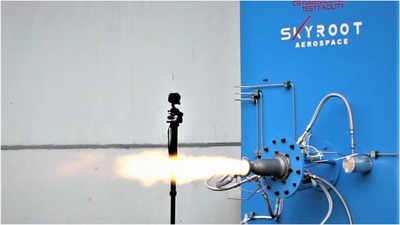
PARIS: Desi space startup test-fires India’s first privately built, 3D-printed cryo engine
PARIS: Desi space startup Skyroot
Aerospace on Thursday achieved a major milestone as it “successfully test-fired
India’s first privately built cryogenic rocket engine Dhawan-1”. Fuelled by LNG
and LoX propellants, Dhawan-1 will be fixed in the upper stage of the company’s
Vikram-2 rocket.
Founded in 2018 by former Isro scientists Pawan Kumar Chandana and Naga Bharath
Daka, Skyroot Aerospace has been developing a series of three ‘Vikram’ rockets,
named after Isro founder Vikram Sarabhai, which are designed especially for
launching small satellites.
Chandana, co-founder and CEO of
the Hyderabad-based company, said the made-in-India cryogenic engine has been
developed using 3D printing with a superalloy, thus reducing manufacturing time
by more than 95%.
“These are rocket propellants of
the future, and this test makes us one of the very few companies in the world
to have successfully demonstrated this technology,” he said.
Skyroot Aerospace has developed a mobile cryogenic engine test stand and tested
the engine at a one-of-its-kind propulsion test facility at Solar Industries
India Ltd, Nagpur.
Cryogenic engines are highly efficient rocket propulsion systems that use
propellants at cryogenic temperatures (less than minus 150 deg C) and are
highly suitable for upper stages of a rocket.
The development of this cryogenic engine is very challenging and so far only
six countries, including the US, China, Russia, France, Japan and India,
possess this technology. Isro has been using this technology to fire its GSLV rockets.
In mid-September this year, Skyroot became the first private company after the
space reforms announced by the Modi government last year to sign an agreement
with the Department of Space for getting “access to Isro’s launch facilities
and expertise towards the development and testing of subsystems and systems of
space launch vehicles”.
In December last year, the company successfully test-fired its Kalam-5 solid
propulsion rocket engine, a larger version of which will be used to power the
lower stages of its Vikram rocket. The company plans to launch its first rocket
next year.
This year, Skyroot raised $11 million in its series A round of funding. “We
intend to raise $40 million more to fund our aggressive growth plans over the
next few years,” Naga Bharath Daka, co-founder and chief operating officer
(COO), had said recently.
About the Author

Some Related Posts
-
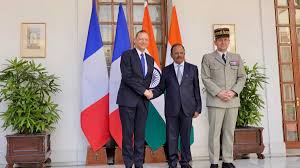
PARIS: 38th India – France Strategic Dialogue
PARIS: Shri Ajit Doval, National Security Adviser to the Prime Minister of -

PARIS: Visit of External Affairs Minister to France and Luxembourg
PARIS: External Affairs Minister, Dr. S. Jaishankar will be on an official -

PARIS: Shri Sanjeev Kumar Singla appointed as the next Ambassador of India to France
PARIS: Shri Sanjeev Kumar Singla (IFS:1997), presently Ambassador of India -
PARIS: Meeting of India-France Joint Working Group on Counter Terrorism
PARIS: The 16th Meeting of India-France Joint Working Group on Counter T -
PARIS: Macron Launches Special French Language Programme For Indian Students
PARIS: French President Emmanuel Macron has announced the launch of ‘