






-
SILICON VALLEY: Indian-origin executive named CEO of Microsoft Gaming - March 5, 2026
-
WASHINGTON: Indian-American lawyer at center of Trump’s biggest legal setback - March 4, 2026
-
TEXAS: ’15 of my cousins came here on H-1B’ - March 3, 2026
-
NEW YORK: Indian-origin doctor shares mother’s immigrant success journey in US - March 2, 2026
-
ARIZONA: Indian-origin scientist wins Arizona State University’s top Science Prize - March 1, 2026
-
WASHINGTON: Balaji Krishnamoorthy becoming Uber CFO amid ongoing visa row - February 28, 2026
-
LUCKNOW: Prime Minister Narendra Modi on HCL-Foxconn chip facility in UP - February 27, 2026
-
WASHINGTON: 55% Indian Americans Disapprove Of Trump’s India Policies: Survey - February 26, 2026
-
WASHINGTON: Trump Praises Indian American Harmeet Dhillon Amid Harvard Case - February 26, 2026
-
MUMBAI: Ranbir Kapoor to set up new RK Studios - February 25, 2026


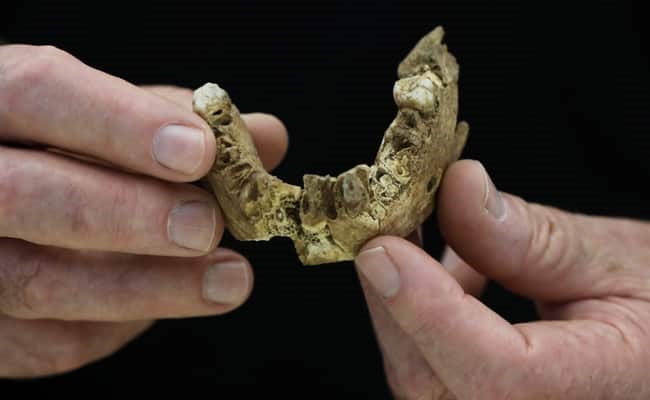
JERUSALEM: “Nesher Ramla Homo”: New Type Of Early Human Found In Israel
JERUSALEM: Israeli researchers they had found bones belonging to a “new type of early human” previously unknown to science, shedding new light on the course of human evolution.
Archeological
digs near the city of Ramla by a team from the Hebrew University of Jerusalem
uncovered prehistoric remains that could not be matched to any known species
from the Homo genus, which includes modern humans (Homo sapiens).
In a
study published in the journal Science, University of Tel Aviv anthropologists
and archaeologists led by Yossi Zaidner dubbed the find the “Nesher Ramla
Homo type” after the site where the bones were found.
Dating to
between 140,000 and 120,000 years ago, “the morphology of the Nesher Ramla
humans shares features with both Neanderthals… and archaic Homo,” the
researchers said in a statement.
“At
the same time, this type of Homo is very unlike modern humans — displaying a
completely different skull structure, no chin, and very large teeth.”
Along
with the human remains, the dig uncovered large quantities of animal bones as
well as stone tools.
“The
archaeological finds associated with human fossils show that ‘Nesher Ramla
Homo’ possessed advanced stone-tool production technologies and most likely
interacted with the local Homo sapiens,” archaeologist Zaidner said.
“We
had never imagined that alongside Homo sapiens, archaic Homo roamed the area so
late in human history”.
The
researchers suggested that some fossils previously discovered in Israel dating
back as far as 400,000 years could belong to the same prehistoric human type.
The
Nesher Ramla discovery calls into question the widely-accepted theory that
Neanderthals first emerged in Europe before migrating south.
“Our
findings imply that the famous Neanderthals of Western Europe are only the
remnants of a much larger population that lived here in the Levant — and not
the other way around,” anthropologist Israel Hershkovitz of Tel Aviv
University said.
Dentist
and anthropologist Rachel Sarig of Tel Aviv University said the find suggested
that “as a crossroads between Africa, Europe and Asia, the Land of Israel
served as a melting pot where different human populations mixed with one
another, to later spread throughout the Old World.”
Small
groups of the Nesher Ramla type likely migrated into Europe, later evolving
into Neanderthals, and Asia, developing into populations with similar features,
Sarig said.
About the Author

Some Related Posts
-
ARIZONA: Indian-origin scientist wins Arizona State University’s top Science Prize
ARIZONA: Indian-origin scientist Meha Jain of the University of Michigan Sc -
HOUSTON: Indian-Origin Climate Scientist Wins Prestigious Crafoord Prize In US
HOUSTON: Indian-origin climate scientist Veerabhadran Ramanathan has been a -

CALIFORNIA: Indian-origin scientist Shri Kulkarni wins Royal Astronomical Society’s Gold Medal
CALIFORNIA: Shri Kulkarni, an Indian-origin astronomer and one of the world -

TEL AVIV: PM receives a telephone call from Prime Minister of Israel
TEL AVIV: Prime Minister Shri Narendra Modi received a telephone call from -

PENNSYLVANIA: 22-year-old Indian-origin engineer rewrites wind energy maths
PENNSYLVANIA: On a quiet afternoon in University Park, Pennsylvania, aerosp