






-
SILICON VALLEY: Indian-origin executive named CEO of Microsoft Gaming - March 5, 2026
-
WASHINGTON: Indian-American lawyer at center of Trump’s biggest legal setback - March 4, 2026
-
TEXAS: ’15 of my cousins came here on H-1B’ - March 3, 2026
-
NEW YORK: Indian-origin doctor shares mother’s immigrant success journey in US - March 2, 2026
-
ARIZONA: Indian-origin scientist wins Arizona State University’s top Science Prize - March 1, 2026
-
WASHINGTON: Balaji Krishnamoorthy becoming Uber CFO amid ongoing visa row - February 28, 2026
-
LUCKNOW: Prime Minister Narendra Modi on HCL-Foxconn chip facility in UP - February 27, 2026
-
WASHINGTON: 55% Indian Americans Disapprove Of Trump’s India Policies: Survey - February 26, 2026
-
WASHINGTON: Trump Praises Indian American Harmeet Dhillon Amid Harvard Case - February 26, 2026
-
MUMBAI: Ranbir Kapoor to set up new RK Studios - February 25, 2026


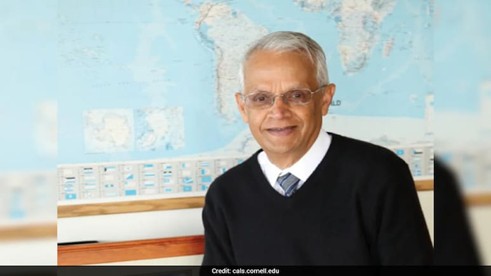
HOUSTON: Indian-Origin Climate Scientist Wins Prestigious Crafoord Prize In US
HOUSTON: Indian-origin climate scientist Veerabhadran Ramanathan has been awarded the 2026 Crafoord Prize in Geosciences by the Royal Swedish Academy of Sciences.
Often described as the “Nobel of Geosciences,” the prize recognises Ramanathan’s decades of research on super-pollutants and atmospheric brown clouds, which have reshaped understanding of global warming.
Ramanathan, 82, made a landmark discovery in 1975 while working at NASA: chlorofluorocarbons (CFCs), widely used in aerosols and refrigeration, trap heat in the atmosphere up to 10,000 times more effectively than carbon dioxide.
“Until 1975, we thought global warming was mainly from CO₂. I was shocked at the capacity of technology and human beings to change the environment,” Ramanathan told the Royal Swedish Academy of Sciences.
Born in Madurai and raised in Chennai, Ramanathan began his career as an engineer in a refrigerator factory in Secunderabad, where he first handled CFCs.
He later earned degrees from Annamalai University and the Indian Institute of Science.
His Indian roots informed his work in the Indian Ocean Experiment (INDOEX), which identified atmospheric brown clouds over South Asia.
The study linked air pollution to a weakened Indian Monsoon and accelerated melting of Himalayan glaciers.
Now, a Distinguished Professor Emeritus at the Scripps Institution of Oceanography, University of California, San Diego, he has also advised global leaders and the Vatican on climate ethics.
The Crafoord Prize carries a cash award of 8 million Swedish kronor (approximately $900,000) and a gold medal. The award will be presented during Crafoord Days in Stockholm and Lund in May 2026.
Ramanathan’s work underpins key international treaties, including the Montreal Protocol, which has prevented millions of tons of harmful emissions from entering the atmosphere.
About the Author

Some Related Posts
-
ARIZONA: Indian-origin scientist wins Arizona State University’s top Science Prize
ARIZONA: Indian-origin scientist Meha Jain of the University of Michigan Sc -

CALIFORNIA: Indian-origin scientist Shri Kulkarni wins Royal Astronomical Society’s Gold Medal
CALIFORNIA: Shri Kulkarni, an Indian-origin astronomer and one of the world -

PENNSYLVANIA: 22-year-old Indian-origin engineer rewrites wind energy maths
PENNSYLVANIA: On a quiet afternoon in University Park, Pennsylvania, aerosp -

SAN FRANCISCO: Indian-Origin Founder Unveils Wearable Device That Records Every Moment Of Your Life
SAN FRANCISCO: Advait Paliwal, an Indian-origin entrepreneur, has recently -

TEXAS: Meet Gopi Thotakura, Indian Who Will Soon Go To The Edge Of Outer Space
TEXAS: In an unprecedented leap towards the stars, pilot Gopichand Thotakur