






-
SILICON VALLEY: Indian-origin executive named CEO of Microsoft Gaming - 2 days ago
-
WASHINGTON: Indian-American lawyer at center of Trump’s biggest legal setback - March 4, 2026
-
TEXAS: ’15 of my cousins came here on H-1B’ - March 3, 2026
-
NEW YORK: Indian-origin doctor shares mother’s immigrant success journey in US - March 2, 2026
-
ARIZONA: Indian-origin scientist wins Arizona State University’s top Science Prize - March 1, 2026
-
WASHINGTON: Balaji Krishnamoorthy becoming Uber CFO amid ongoing visa row - February 28, 2026
-
LUCKNOW: Prime Minister Narendra Modi on HCL-Foxconn chip facility in UP - February 27, 2026
-
WASHINGTON: 55% Indian Americans Disapprove Of Trump’s India Policies: Survey - February 26, 2026
-
WASHINGTON: Trump Praises Indian American Harmeet Dhillon Amid Harvard Case - February 26, 2026
-
MUMBAI: Ranbir Kapoor to set up new RK Studios - February 25, 2026


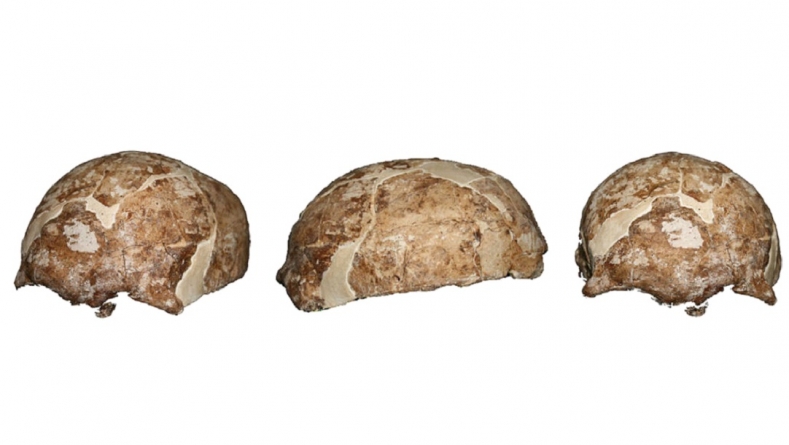
BEIJING : Ancient DNA links an East Asian Homo sapiens woman to early Americans
BEIJING : DNA from this approximately 14,000-year-old partial skull (shown from multiple angles) found in southwestern China pegs the find as a member of a Homo sapiens population with genetic ties to Native Americans.
A previously undetected Homo sapiens population inhabited what’s now southwestern China around 14,000 years ago and contributed to the ancestry of ancient Americans.
This far-ranging Asian group’s evolutionary identity has been revealed thanks to ancient DNA extracted from a skullcap previously excavated at Mengzi Ren, or MZR, a site in southwestern China’s Red Deer Cave, researchers report July 14 in Current Biology.
The finding offers a rare opportunity to narrow down where the ancestors of ancient Americans came from in East Asia’s vast expanse.
Geneticist Bing Su of China’s Kunming Institute of Zoology and colleagues recovered nearly all the fossil individual’s mitochondrial DNA, typically inherited from the mother, and roughly 3.3 percent of the nuclear DNA, which is inherited from both parents.
Hominid fossils unearthed at Red Deer Cave in 1989 look like those of people today in some ways but in others resemble Asian Neandertals and Homo erectus
The new genetic analyses and comparisons with present-day and ancient people peg the MZR individual’s DNA as that of a female H. sapiens from southern East Asia. Much like East Asians today, the ancient female’s ancestry included small contributions from Denisovans and Neandertals.
Su’s group found that the MZR woman carried genetic ties to ancient people in the Americas who date to as early as about 12,000 years ago. Some ancient southern East Asians traveled up China’s eastern coast, possibly by way of Japan, and crossed a land bridge to North America, the scientists suspect.
About the Author

Some Related Posts
-

BEIJING: Foreign Secretary meets Executive Vice Foreign Minister of China, Mr. Ma Zhaoxu February 10, 2026
BEIJING: Foreign Secretary Vikram Misri held the India China Strategic Dial -

BANGKOK: Visit of Minister of Foreign Affairs of Thailand to India
BANGKOK: The Minister of Foreign Affairs of Thailand, Mr. Sihasak Phuangket -

BEIJING: “Arunachal In China”- Indian Woman’s Post On Shanghai Airport Harassment
BEIJING: A woman from Arunachal Pradesh has accused the Chinese authorities -

BEIJING: Meeting of Prime Minister with Mr. Xi Jinping, President of the People’s Republic of China on the margins of the 16th BRICS Summit
BEIJING: Prime Minister Shri Narendra Modi met with Mr. Xi Jinping, Preside -

BEIJING: 29th Meeting of the Working Mechanism for Consultation & Coordination on India-China Border Affairs
BEIJING: The 29th meeting of the Working Mechanism for Consultation & C